
Pattern Catalog

| Dead Letter Channel |
Pattern Catalog | |
| Site Home • Patterns Home • Table of Contents |
An enterprise is using Messaging to integrate applications.
What will the messaging system do with a message it cannot deliver?
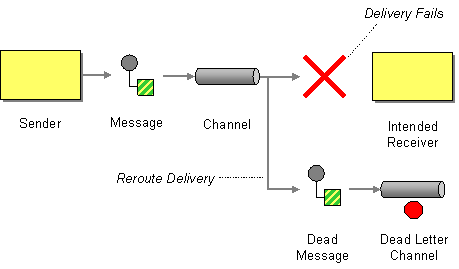
When a messaging system determines that it cannot or should not deliver a message, it may elect to move the message to a Dead Letter Channel.
The specific way a Dead Letter Channel works depends on the specific messaging system’s implementation, if it provides one at all. The channel may be called a “dead message queue” [Monson-Haefel, p.125] or “dead letter queue.” [MQSeries], [Dickman, pp.28-29] Typically, each machine the messaging system is installed on has its own local Dead Letter Channel so that whatever machine a message dies on, it can be moved from one local queue to another without any networking uncertainties. This also records what machine the message died on. When the messaging system moves the message, it may also record the original channel the message was supposed to be delivered on.
...Related patterns: Invalid Message Channel, Message Expiration, Selective Consumer, Messaging

For a full description of the pattern see:
 | Enterprise Integration Patterns
Gregor Hohpe and Bobby Woolf ISBN 0321200683 650 pages Addison-Wesley |
| Home • Patterns • Table of Contents |  Previous Next Previous Next  |
 | © 2003 • Bobby Woolf • All rights reserved. |